-->

Wednesday, January 03, 2007

Peddling the Word of God for Profit (a follow-up exchange)

My friend Peter posted a challenging and helpful comment to my post on selling Bibles for profit. Without his permission -- and I'll change this post if he says otherwise -- I have decided to respond to him in a post rather than in the comments (because my response was becoming far too long!). I'll reprint his thoughtful comment here, and respond to it below:

Continue reading Peddling the Word of God for Profit (a follow-up exchange)

Jay:You seem to be missing a link in your chain. Let's not forget this
whole thought began with a purchased Christmas Card. Someone's making some
scratch off that as well.

But besides that, they are many ways someone can get their hands on
scripture for no cost. Some churches and other organizations give them out for
free. But you are paying for some service, perhaps some concordence and some art
from Zondervan.

However, don't just look to Bible publishers. Is their duty to spread the
word any different than clergy? How much should clergy be paid? What is too
much? What if you didn't get paid for the sermons you preached but instead the
church found a very worthy charity and sent the money to them?

Of course I'm taking this to an extreme. As one who lists many clergy in my
immediate family and friends, I'm not suggesting that we stop paying clergy. But
I know that the package my church provides; salary, housing allowence and car
allowence, to our pastor is approx. $xx,xxx.* Pastor Matthews has 35+ years in
ministry and has help guide the growth of our church. Could he do with less?
Yes. But the congregation votes every year on his compensation. So the people
most influenced by his work agree to that level of compensation.

Pete,
Thanks for this opportunity to return to the initial thoughts which stimulated this post.

Actually, within the parameters of my post, your comparison of clergy and Bible publishers is wide of the mark, as there is a relevant difference between the two: namely, profit. The salary paid to a minister is not something which is potentially limitless; on the contrary, it is a set compensation which will not go above the agreed upon amount, nor will it (I presume) go below the agreed upon amount. Profit, on the other hand, is potentially limitless. (It might also conceivably be negative, in the case of a loss.) To put onself in the place of a potentially limitless personal/ private gain through selling Scripture is problematic in a way that compensating someone an agreed amount is not.

But I am willing to (hypothetically) bite the bullet. You brought up paying pastors as a reason that selling Bibles for profit is acceptable; I am willing, for the sake of argument, to bite the bullet and allow that paying pastors might actually be problematic. Paul, at certain points, makes a something of a similar point, stressing that he was supported by the work of his hands and (apparently) other congregations, in doing his missionary work. (Again, I suspect this is relevantly different than modern-day priests and pastors, but let's give it a broad reading.)

I should stress that this is only hypothetical, and that in fact almost all pastors I know work quite hard and would do so for far less than they make -- and would also do it for free if that was the only option. Some clergy I know (me, for example) use the following rationale for their compensation: I would do this for free, since it's my vocation and what I naturally do. Moreover, the sacraments, the ministry, the Word of God, teaching, etc., are not to be 'sold', not to be profited from, so I can't 'charge' people for this work in the first place. But if I did it for free, I would need to go out and find another job to feed, cloth and house myself and my family. And if I did go out and find another job -- an entirely fair expectation -- then I would be taken away from and distracted from the work of service (ministry). This can be gotten around if a congregation is willing to 'buy my time', that is, offer me a stipend so that I can focus on this work rather than earning my living another way. And so, some package is offered (typically quite generous on the congregation's part, but not something one would become wealthy off of), so that the person can concentrate on serving God, the church, and the world.** (As I understand it, this is the same rationale -- mutatis mutandis -- that rabbis use for receiving their salaries: study and teaching of the Law are to be free, for all.)

But to return to my 'biting the bullet': perhaps paying pastors is problematic, since it is (in some sense) 'peddling the Word of God for profit'.*** This forces me back onto my larger theological point, which I can restate in broader terms here: if the word of God (broadly construed) is what we think it is, then it will have Godly, world-changing effects and not merely give rise to the private, personal benefit of an individual. Or to push it in a slightly different direction: if a constituent part of the Christian life is to grow in the grace of God through the Holy Spirit, then the major effects of this will be the Christian growing in love and holiness (that is, reflecting and participating in the 'character'**** of God), and these are not things which can be 'hidden under a bushel basket' or will have no effect in the world, and hence they are not things which will exist for the private benefit of an individual.*****

You see, of course, that this has gone well beyond the question of paying pastors, to ask the larger -- and more deeply existential -- question of what good is the church in the world? Do we (as Bible publishers, pastors, laypeople, whatever) live only for ourselves? And isn't that idolatry (in the sense that God then exists as our personal benefactor rather than as he is)? This might end up being a disconfirmation of the work of the Holy Spirit in our midst, which if true would be devastating. Or it might be, and this is my hope, a wake up call to reassess our priorities across the board, to make personal and systemic changes, so that we might better reflect the reality of the God who 'wonderfully made us and yet more wonderfully redeemed us' through Jesus Christ, and who is present and active in the church and the world.


* It didn't seem important to the point to reprint Pastor Matthews' salary here. It is, of course, publicly accessible if such information is important to you, the reader.

** It is just this, actually, which causes me to have misgivings about churches increasingly feeling that they have to put together compensation packages that take their major cues from industry and business. Some of the current trends in clergy salary -- at least in the denomination I'm most familiar with -- are pricing priests out of the market. And, although I'm not in favor of starvation wages either, I'm not sure that the present trends encourage the idea that this vocation is (as all Christian life is) one of service, rather than a 'profession' in the contemporary sense, requiring primarily executive and managerial skills.

*** It was an ambiguity in my first post, through using that title: the 'Word of God' mentioned by Paul, was not Scripture per se, but the word of good news of salvation and new life through Jesus Christ. It was a word accompanied by what we call the Old Testament, certainly, but it was primarily a spoken word. Paul was not speaking about selling Bible door-to-door. This doesn't affect my first post, or the points made therein, but simply clarifies the ambiguity in the title for those who might not have known the background.

**** I'm not usually comfortable with talking about God's 'character' for a number of reasons, but the term seems to fit here.

***** Implicit in my making these points parallel (about the word of God and the church) is the notion that the church is more than a sociological reality, but as the body of Christ is meant to continue (in certain ways) the mission and service of the Son of God in and for the world. This is, of course, not done apart from God.

Labels: , , , , ,

Saturday, December 23, 2006

Targeting Che

Target stores, an American discount department store, has withdrawn CD cases offered for sale which featured the picture of Communist revolutionary Che Guevara. It has also offered an apology to those whom it offended. A story in the Chicago Tribune relates the tale here.

What particularly caught my eye were the following brief paragraphs:


Guevara photos are often seen on T-shirts and posters, but some critics thought Target went too far when it put Guevara's photo on a Target-branded item it was selling in stores. Guevara, a key figure in the Cuban revolution, has been frequently criticized on the right for his violent tactics.

"What next? Hitler backpacks? Pol Pot cookware? Pinochet pantyhose? Target gives this monster a pass, while using common sense on almost everything else it sells," Investors Business Daily editorialized on Dec. 13.

First I must say that it strikes me that we have missed a golden marketing opportunity: who could resist buying Himmler hot pants? I ask you. Investors may make contact with me in care of this blog.
But more seriously, this line is deeply confused: '[Che] has been frequently criticized on the right for his violent tactics.' This is wrong; Che has been frequently criticised on the right for being on the left. The right, or at least certain elements of it (at times including America), have been entirely willing to employ violence in whatever cause they have found compelling. To take an obvious example from the above paragraphs, General Pinochet staged a coup in Chile against a popularly-elected leftist president, with the support of America, and during his time in power killed and tortured numerous people who were considered 'dangerous'. Now, obviously no one has suggested putting Pinochet's picture on children's lunchboxes or what have you, but that is not the point, this is: (certain elements of the) right, left and centre have all employed violence to achieve ends they have thought worthwhile. For conservatives to cavil at the use of Che's image because he was violent seems distinctly hypocritical.
Honestly, I have often thought that the adaptation of Che's image for use in all sorts of consumer goods, particularly t-shirts, to be a singularly ill-fitting tribute to the man who fought for the people's revolution in parts of Central and South America and Africa. His image has been co-opted to support and drive the very sort of consumer capitalism that he resisted, so that certain well-placed people can become fabulously wealthy whilst so many others are kept in menial, demeaning, ill-paid jobs. (I'm willing to bet that the t-shirts which bear his likeness are not made in domestic, unionised shops -- but I'm willing to be corrected with sufficient evidence.) Which brings me to this final observation:
It seems to me that, given the sort of deep insult it is to Che's memory to have his image become part of consumer capitalism with all its attendant problems, the right would be supporting just this sort of trivialisation of the man and his memory. I find it deeply troubling.
Unless I can find someone to market my "Che" brand designer jeans. (Enquiries in care of this blog, please.)

Labels: ,

Monday, October 09, 2006

The Logic of the Glory of the Lord and the Logic of the Market

It occurred to me on Sunday that there is a distinct contrast between the logic of the glory of the Lord and the logic of the glory of the market, that in fact the logics are inverses of each other.

And by 'market', I mean nothing more technical than the sort of consumer-oriented and -driven sort of economics that most of us encounter on a (mostly) daily basis, a product of modern, Western, liberal capitalism, of which one of the hallmarks is a strong statement of individualism.

The logic of the glory of the market looks something like this: You are a subject with needs and desires which are inviolable, the nearest thing to absolute. There are various and sundry means which you may choose to engage as a means of fulfilling your desires/needs, means towards whichever ends you envision for yourself (or no ends in particular).

[If you want to press me on the 'glory' of the market, go ahead; I chose not to spell it out in great detail here, as I wanted to keep this a brief(er) post.]

So the model is: absolute agent --- various means --- any particular end

But the logic of the glory of the Lord (specifically, our participation in it) looks something like this: the glory of the Lord is absolute - beauty, goodness, praiseworthiness, weight and honour which are attractive and worthy in themselves. This glory, though, is active (rather than static) and self-involving, drawing us in to embody, participate in, and spread. There is a deeply trinitarian logic to this process of glory (and glorification), which I will elaborate on at another time (and have elaborated on before).

Rather than being caught within ourselves as absolute and autonomous agents, we are called out beyond ourselves to more - in a process through the Holy Spirit called by one author ecstasy and intimacy - relativising ourselves through various means in service to the truly worthy. This turns the logic of the market on its head, as we are no longer the sovereign subject matching means to ends (the echo of A. MacIntyre is intentional), but ourselves are relativised and even become means for the one end which is truly worthy in itself.

So the logic might be expressed: absolute end (glory) --- various means --- relativised agent.

(I'm sorry, I was able to devise a somewhat clearer, cleverer schema on Sunday, when I did it on the fly -- or perhaps I simply didn't catch that it wasn't as elegant as I fancied.)

In any event, the focus and the process are altogether different, the one focusing on and leading to the sovereign subject, with no fixed end, and the other focusing on and leading to the glory of the Lord (in fact, the Lord), with a fixed end.*

This becoming means is not a call away from the world, the relationships and so forth that comprise our lives -- any more than Christian mystics, properly understood, advocated a withdrawal from the world. I would argue, rather, that this becoming means of God's glory in the world, or more simply, glorifying the Lord with our lives, is the way that we are truly able to engage our lives as who we are and who we are meant to be.


* Sharp-eyed observers might counter that the glory of the Lord is absolute, but might be underdetermined -- or at any rate, not yet fully revealed in time -- and therefore not materially absolute as an end even if formally absolute. I would endorse this distinction, while yet maintaining that being formally absolute is sufficient for my point of contrast. (That is to say, we might not yet fully know the glory of the Lord, not least because it is unfolding in time and we haven't yet seen all time; but we might still be able to say that 'the glory of the Lord' is in fact an absolute, worthy end in itself, even if we do not know fully what that looks like. Sort of like we might say that 'I am riding this train to Birmingham', even if I don't know precisely what Birmingham looks like.)

Labels: , , , , ,

Friday, August 18, 2006

Rat Eat Dog

I am reading in my spare time (pause to allow laughter to die down) Chew on This: Everything Your Don't Want to Know about Fast Food by Eric Schlosser and Charles Wilson. It is nothing too groundbreaking, most everything I have run across can be found in Schlosser's earlier work Fast Food Nation. But the two following quotes from Ray Kroc caught my attention:

"If you believe in it, and you believe in it hard, it's impossible to fail. I don't care what it is -- you can get it!" (p.30)

and, on competing with fast-food rivals:

"This is rat eat rat, dog eat dog. I'll kill 'em, and I'm going to kill 'em before they kill me. You're talking about the American way of survival of the fittest." (p. 33-34)

There is so much that can be said about either of these quotes, but they seem especially jarring when juxtaposed like this. The venom of the second quotation makes the vapid ideology of the first just that much clearer: it doesn't actually matter what you want or what you believe in or how hard you work, because it is entirely likely that you will run up against someone who wants to 'kill' you. It is striking just how primal the myth of ultimate violence is in the second quotation; even more striking that this dispassionate 'killing' is likened to 'the American way'.

And, just in case the buzzcops out there think I am being one-sided, let me add: And all the more striking when one considers that Kroc's widow, Joan Kroc, contributed millions of dollars to the centers for peace and justice studies at Notre Dame University and University of San Diego, as well as a substantial contribution to the Salvation Army. When she was alive, she also contributed million for nuclear disarmament. So I suppose this poisonous ideology doesn't always have the last word.

Labels: , , ,

Wednesday, July 05, 2006

Would Jesus Blush?


Aaron Ghiloni, to whom I should link in my sidebar, has posted briefly on the release by Thomas Nelson publishers of a magazine-style Bible in an entry entitled Jesus at the Clinique Booth.

The substance of Aaron's post is a quotation from a representative of Thomas Nelson:

"The main criticism we get is that we have trivialized scripture by putting images of girls on the same page. But if Jesus was here today, he'd be hanging out at the Clinique booth with teen girls. He went where the people were, and that's the message of the Bible--it's about understanding the connection between the Bible and the world that we live in."
- Laurie Whaley, brand manager for Thomas Nelson, publishers of a magazine-style Bible. Reported here

Frankly, it does trivialise Scripture -- in fact, 'special interest' Bibles of all kinds do that, this isn't unique in that way.* But I wonder if the way that we have culturally constructed the idea of 'girls' or 'teen girls' itself implies trivialisation -- not of the Bible, but of the people, these young women. Is there perhaps then a difficulty in making a Bible for these people which reinforces that stereotype?

If that isn't clear, or you don't see it as a problem, then how about a thought experiment? What if we travelled back in time 150 years in the US and entered the precursor to the Thomas Nelson Publishing Company and joined a meeting there? Perhaps they would be discussing the new issuing of a gift Bible for Christmas.** But why not introduce the idea of study Bibles for certain audiences -- maybe a Bible for slaves, for example? Of course the visceral response that evokes in us (right?) is because we object so strongly to the institution of slavery: to have a Bible which is aimed at this group seems to endorse the continuance of this foul practice. 'Slave' is a way of culturally constructing the identity of a person (i.e. a piece of property, 3/5 of a person, etc.); it can be contested. So also can the way that we construct the identity of 'teen girl', in a way that does more than trivialise and marginalise these people in society.

What Ms. Whaley -- no doubt speaking for more than just herself -- fails to grasp is that Jesus did not merely imitate (and, by implication, endorse) the cultural trends of his day for the sake of some (extra-cultural?) 'message'. Jesus 'hanging out at the Clinique booth with teen girls' is rather ambiguous. Are we meant to think of him there, just chilling? Or would it be more likely that he would be getting to know the women there and challenging them to leave behind the false, overpriced, self-centred, shallow stereotypes that they are consuming their lives to fulfill and instead denounce Clinique et al, and call them into a fuller life in God, loving God and their neighbours? It is clear to me which he would do. It is not that he would steer clear of the Clinique booth (or wherever), but that he would demand more and offer more. But perhaps we have been reduced to offering 'magazine-style Bibles' because we in the church have failed to offer the sort of alternative we are called to do. If we don't/can't offer an example of new life in God, maybe our practices of marketing can.

Or not.

To answer the question posed in the title of this post, I'm not sure if Jesus would blush or not. But I think that Ms. Whaley and Thomas Nelson Publishers -- heck, all the rest of us -- ought to.


* This is not to say that there is some 'pure' Bible that we alone need to focus on: I think Biblical texts without columns, or chapter or verse numbers might be quite helpful. I tend to support Eugene Peterson's interpretation of the Bible (The Message). And I allow no quarter to the tired old hacks who insist that the KJV/ Majority text is the only true translation. But these sorts of products -- I use the term advisedly -- do seem different, whether it is the teen boy/girl Bible, the Precious Moments Bible, or the Scofield Study Bible (with words of Scofield in red), it is laying a filter over Scripture of which we ought to be suspicious. That's not to say that a commentarial tradition (such as is found in the Talmud in Judaism) is illegitimate; but the Talmud is a living tradition of commentary over centuries, not merely the best guesses based on Whatever's Popular Now.

**This is based on truth. Bibles were among the first gifts given in the 'traditional' industrial-age Christmas we celebrate in the West, and they were often fancied up with leather bindings, etc.

Labels: , ,

Tuesday, May 02, 2006

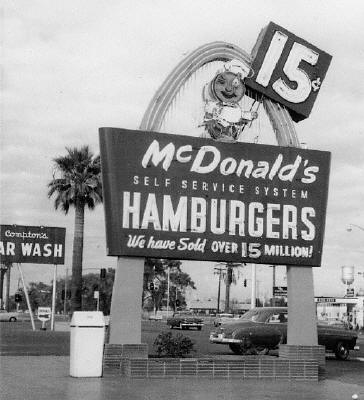
McDonald's, Schlosser, Buzzcops, and all that...

I wanted to write a bit more about the whole controversy about McDonald's, Eric Schlosser, the buzzcops and all that.

First, to the buzzcops: hi! Welcome back to the Street. How is New Hampshire (or Virginia, or D.C.) this time of year?

Now, as to my theory that there are such folks as buzzcops around: I've done a bit more looking. McDonald's is taking the new book by Schlosser, Chew on This, very seriously. It is a version of his previous book, Fast Food Nation, which has been re-conceived to be aimed at teenagers. Alongside this, a new movie is being released later this year, a fictionalisation of his earlier book Fast Food Nation (not a documentary like the earlier Super Size Me), which they are concerned about.

In fact, according to a news story at The Guardian, McDonald's is taking pre-emptive action against Schlosser:

Internal McDonald's documents reportedly show that the company is shifting into "crisis management" mode in advance of Chew On This, a young people's version of Eric Schlosser's book along with a forthcoming film adaptation of Fast Food Nation. The plans speak of mobilising a "truth squad" to attack both works, and of initiatives to "discredit the message and the messenger".

Plans sent to McDonald's franchisees, originally obtained by the Wall Street Journal, seek to reassure restaurant managers that "a lot of work is going on behind the scenes ... from a crisis management standpoint" - part of a "full-scale media campaign" to tell "the real story" about the world's largest restaurant chain.

(Read the entire article here.) (There's a similar article in the Independent -- but it needs registration, first.)

This seems to support my idea that there might well be people paid to surf the internet and monitor the buzz around Schlosser, et al, and when 'word on the Street' doesn't go their way, to offer counter-buzz (or what some might characterise as ideological disinformation). Such disinformation might well take the form of ad hominem attacks (to discredit the...messenger) and non sequitur innuendo. Of course, these are not the methods used by someone who has a good case to make, they are the sorts of things that people do (at least, do intentionally) when they know they don't have a leg to stand on.

What sort of a "truth squad" would seek to discredit the messenger? And doesn't 'truth squad' sound like nothing but 1984-ish newspeak, which would call a lie the truth?

Now, in fairness to McDonald's, they deny acting to discredit the message and messenger (in the same story in the Guardian). On the one hand, that is naturally what they would say, acting in their own defense; on the other hand, if it were true then our cynical suspicion of them would keep us from the truth. I would be willing to believe them...but for the presence of the buzzcops, who obviously act otherwise.

An article in the marketing trade journal Advertising Age reported on this topic as well. They reported that insiders say that McDonald's is 'panicked' about the forthcoming movie. The article also says that:
McDonald's response to these threats will likely focus on moves it has already made. In the past two years it has rolled out more-healthful offerings like salads, milk and apple slices to offset its more indulgent fare, but it has also invested heavily in public relations platforms focused on healthful lifestyles and activity.

The fast-feeder set a global advisory council on balanced active lifestyles and turned clown icon Ronald McDonald into a fitness ambassador. In addition, the chain put nutrition information on packaging and hosted a quality symposium and Internet campaign to tout and "bust" myths about its food quality.

And I must say, apart from the disinformational potential of the last half-sentence, these are laudable moves. They have indeed added healthier options to their menu and taken other positive steps.

Moreover, Schlosser is not someone with an irrational desire to 'get McDonald's' (or other fast food restaurants). He has specific concerns, developed from his research. As the Ad Age article ends:
Mr. Schlosser wants to hear from them. "I hope [McDonald's] engages in a substantive debate about the issues raised by the film and avoid personal attacks on the filmmakers, not to mention the threat of legal action," he said. "They get their point of view across every single day on TV. If they believe in democracy, they should welcome criticism and debate...and not engage in the kind of personal attacks that are attempts to distract people from the really important issues."

Finally, you might take a few minutes to look at the Kaiser Family Foundation's report on the role of media in childhood obesity. It is appropriately nuanced in its findings, but suggests that the marketing of fast food and junk food to children through television advertising likely plays a large role as the 'main mechanism' by which media contributes to childhood obesity. So the concerns about fast food companies marketing to young children is warranted.

Labels: , ,

Wednesday, April 26, 2006

Yet Another Turn Off: Give Me a Break Today

I love comments from folks on my posts (well,when they're not spam...). And ongoing readers will know that I am never averse to responding to comments. But there hadn't been many comments recently -- maybe I wasn't writing anything controversial, I don't know. Then I posted on Eric Schlosser and McDonald's, and what do you know? Four comments! I responded to them at some length, and then realised that I wanted to say a bit more, and say it as a post in its own right. So here we go.

First, to you four: welcome to Gower Street! Allow me to register my surprise that all four of you seem to have taken my post as the opportunity to join blogger. What a surprise! (By any chance do you four know each other?)

Thank you for your thoughts.

I find it odd -- and rather dismaying -- that each of you decided to focus on Mr. Schlosser's 'background' (each of you used this very word). In terms of logic, this is called "argumentum ad hominem", a logical fallacy. That is to say, one cannot defeat someone's argument by saying bad things about that person; any number of things might be true about Mr. Schlosser, but that has no bearing on whether or not he is right. This kind of argumentation is a distraction. (For a biblical example of this, when Balaam's donkey spoke, Balaam did not discount it because it was a donkey; he did not "consider the source".) If Schlosser takes a position you disagree with and think is wrong (on decriminalising marijuana, for example), that does not mean that his facts (or motives) are instantly suspect when it comes to, say, the number of adverts on TV devoted to fast food. We need to focus on the truth of the matter, not distracting side issues.

I say that I am dismayed, but it is not just because you four -- independently of each other? -- slipped into the same problem. No, I'm dismayed because it seems rampant today. You hear this sort of thing all the time in relation to Bill Clinton, for example: because he lied about Monica Lewinski you can't trust him on anything. And this kind of sloppy thinking is not limited to those on the right, either: you hear the same sort of thing about George W. Bush: because he lied/ cooked the books/ was culpably misinformed about WMDs in Iraq, then how can we trust him on anything? And these two are only the tip of the iceberg when it comes to this (believe me, for me to even invoke their names makes me feel as if I've constructed straw figures).

More than that, I am dismayed that you four have changed a disagreement with Schlosser's arguments into insinuations about his moral character. And the allegations you make are unsubstantiated, or only vague and suggestive. Is Schlosser "sensationalist"? If so, does that preclude him from telling the truth? Does it mean he necessarily distorts facts? Or does it mean the topics he addresses are surprising, thus causing a 'sensation'? If he does indeed propose reforming the American justice system (v-v drugs, etc.), what arguments does he raise? How are those arguments right or wrong? Or does simply raising a question about the justice system make someone of bad character?

Moreover, I think that blaming the food industry is part of it. They are not merely "communicating their message". They spend millions of pounds, millions of dollars every year to persuade us to buy their food. My point about more people globally recognising the McDonald's arches than the cross: while that can be substantiated, the point is not to blame McDonald's, it is simply to put into perspective just how driven and effective their marketing is. I mean, gosh, we've had 2000 years; they've had, what, 60?

Or I'll tell you a personal story. We rarely eat fast food. My 4-year old daughter has eaten at McDonald's, maybe ten times in her life. Maybe a little more but not much. When she was something like one and a half or two she could identify the McDonald's golden arches, and say she wanted to go there. Is their marketing to kids effective? You tell me.

Like my brother said to me in an e-mail: we wouldn't even be having this conversation if, instead of every five minutes talking about a burger and fries, fast food marketers started talking about how cool it is to eat salads and how being healthy is fun and makes you popular. How awesome would McDonald's look in 20 years if they singlehandedly led a huge push for health for children?

Yes, of course we are responsible for ourselves as well. I'm pretty tired of the argument that says we shouldn't talk about or demand improvements from other parts of society because we ought to take responsibility for ourselves. I don't know anyone who is criticising a fast food chain and saying that it is all their fault. (And if anyone is, they ought to know better.) But to say that it is not all their fault doesn't mean that they have no responsibility for what they say and so. And part of being responsible for ourselves is being responsible for our cultural environment, making discerning choices and demanding changes when they're needed -- like marketing to impressionable children. And part of being personally responsible also means being moderate in your intake of certain things: fast food, tobacco, alcohol, sweets, and so forth.*

We are shaped as people not simply by our wills, but by our environments. So why not do something to shape that?

And if anyone is not yet persuaded at the size and power of the global culture industries -- McD is only the tip of the iceberg here, but a big one** -- then I heartily encourage you to read The (Magic) Kingdom of God by Michael Budde. He does an excellent job of describing the environment in which the church is trying to form disciples, and the pitfalls that we encounter in the face of media and marketing. (This was, you will recall, my major point in the original post.)

Finally, the (often implicit) argument that our concern should be primarily or solely on ourselves and our children and not on others (such as McDonald's) actually supports the idea of legalisation of drugs and the spread of pornography. (This is a common libertarian point.) After all, if my responsibility is for myself only, then why should I worry if someone else is getting smoked up or watching degenerate filth in the privacy of their own homes? If, on the other hand, you don't think this is just fine, then perhaps McDonald's -- or other places, too, I don't mean to single them out over, say, Burger King, or whatever -- might be fair game for legitimate concern, too?


* And lest any of this sound like I wish to outlaw fast food or some other non sequitur, I assure you, if you haven't gotten the point of my post it is this: 1) certain marketing practices ought to change and 2) notice the sort of environment that the church is in; how does it effect us in our formation as Christians? Although I don't tend to eat fast food, I have no desire to get rid of it, but rather to encourage moderation. Britons are learning this, thank God, as sales of fast food and greasy or sugary snacks have fallen, and sales of whole grains and fresh fruits and veg are up.

** How big? Last year, McDonald's reported revenues of $20 billion (£11bn), setting a record for the company. That sounds like a lot -- and it is: it's larger that the Gross Domestic Product of Costa Rica. If it were a country, it would have the 80th largest GDP in the world. (Of course, the real big boys like Wal-Mart and ExxonMobil dwarf McDonald's -- and most other nations, as well.)

Labels: , , ,

Monday, April 24, 2006

Another Turn Off: You Deserve a Break Today

And just in case you're lacking for reasons to turn the set off, especially if you have kids, there was the essay in The Guardian's G2 section today by Eric Schlosser, author of Fast Food Nation : What the All-American Meal Is Doing to the World. The essay, which is an excerpt from his new book, targeted at children, entitled Chew On This : Everything You Don't Want to Know About Fast Food. Here are some mouth-watering starters: (Click here for the whole thing.)

The relationship between big companies and small children has changed enormously in the past 30 years. Until recently, just a handful of companies aimed their advertising at children and they mainly sold breakfast cereals and toys. By 2002, however, the top five food advertisers in the UK were McDonald's, Coca-Cola, KFC and Pizza Hut. British food companies now spend £300m every year advertising to kids. Business people now realise that kids have a lot of money to spend and a lot of influence on what their parents buy. Every year in the United States children are responsible for more than $500bn worth of spending. Big companies want that money. And too often they are willing to manipulate kids in order to get it.

[further down the column...]
The latest scientific research is also being used to make kids buy things. At the Singapore conference, Karen Tan, representing Coca-Cola, discussed how to make children remember a company's ads and create "brand stickiness". According to Tan, research has found that one way to make a lasting imprint on a child's mind is to run the same advertisement over and over again. Repeating the same ad for a product is more effective than running a variety of different ads. The more times a child sees exactly the same ad, the more likely he or she will remember the product.

The average American child now spends about 25 hours a week watching television. That adds up to more than 1.5 months, non-stop, of TV every year. And that does not include the time spent in front of a screen watching videos, playing video games or using a computer. Aside from going to school, American children now spend more time watching television than doing anything else except sleeping. The average British child spends two hours and 20 minutes every day watching television and 25 minutes playing video games. In the UK, more than half of children under the age of 16 have a television in their bedroom.

During the course of a year, the typical American child watches more than 40,000 TV commercials. About 20,000 of those ads are for junk food: soft drinks, sweets, breakfast cereals and fast food. That means American children now see a junk food ad every five minutes while watching TV - and see about three hours of junk food ads every week. American kids aren't learning about food in the classroom. They're being taught what to eat by the same junk food ads, repeating again and again.

I think, given the all-out onslaught of commercial -- and other -- messages that our children are exposed to in a typical week, turning the television off might be a good option. Why?

I know many, many dedicated and hard-working people who work to catechize our children in the church, helping them to come to a full and mature faith. But knowing this, the extent and intensity of marketing messages that we are exposed to, it seems overwhelming. How can we possibly contend? They -- the fast food (and other) marketers -- are able to get in a word every five minutes on average, three steady hours a week. If we are lucky, in church, we might get one hour twice a week; sometimes less. They have £300m and the all-pervasive, persuasive medium of television; we have spare change and flannelgraphs.

I'm not suggesting that fast food and the church are antitheses. But I am suggesting that, as Christians, we are to be intentionally formed most deeply by God's story more than any other. And when any story, even the one about McDonald's, is as all-pervasive as that, there might be a problem. For example, more people in the world recognize McDonald's "golden arches" than recognize the cross. (This fact is from Schlosser's first book.) How far are we from replacing "Glory to God in the Highest" with "You Deserve a Break Today"?

Read the rest. And, while you're at it, do you dare to find out just what is in that "Strawberry" "'Shake'" that you crave?

Labels: , , ,

Thursday, February 24, 2005

Convergence

AKMA posted a helpful and, as ever, well-nuanced rumination on church marketing and management, arriving at the perhaps-surprising conclusion that it isn't all to be rejected.

Also, The Ooze has offered a critique of management theory in the church. I don't know the Ooze well (as with so much else, I found the blog through AKMA), but I suspect he has a more Baptist/evangelical orientation towards the topic than I would take. Please understand that that is not in itself a criticism of him or his critique; I think he has much good to say, but takes a somewhat different tack than I would.

Labels: , ,

Saturday, February 19, 2005

Argumentation and Evidence I: church marketing followup

In a previous post on marketing and the church I made several claims, such as that the secular practice of marketing was a version -- a nihilistic version -- of the sort of revivalism that was popular in the nineteenth century, particularly in the Second Great Awakening. I further made the claim that the church ought to reject secular marketing practices, since they are a secular and nihilistic version of a dubious (and likely heretical) development in the church. (Or, if you're not so confident that revivalism is a dubious or heretical development in the church, I'm willing to make a weaker claim that, at least for those churches which eschew revivalism, marketing should not be embraced as it presupposes an ecclesiology which is at variance with their own.)

Peter pushed me to define church marketing and I put him off. I thought I would get to it later that week, but, well, things piled up as they tend to do. So here at last is a rough-and-ready outline of what I mean.

First, what I don't mean: I don't mean that evangelism is to be rejected. Certain forms of it might lean over into church marketing as I mean it, and should be examined carefully, but evangelism itself takes many, many forms and has been a key part of the Christian faith since the beginning. Most any reader of Gower Street who calls him- or herself a Christian is so by virtue of the church's proclamation of the good news: even if one grew up in the church, then one's parents, grandparents, or some previous generation lost in the mists of time heard the good news in one form or another and left whatever they previously knew to become part of the church.

Straightforwardly, although somewhat narrowly, church marketing would be forms of evangelism (usually corporate evangelism, corporate meaning "as a body" not "industrial"), which self-consciously employ the tactics and strategies of secular marketing, especially to the degree that the practices and categories of that marketing submerge the practices and categories of the Christian story. For example, in the book God is Not..., one of the chapters critiqued the idea that God is a capitalist, and specifically took aim at the book Jesus CEO: Using Ancient Wisdom for Visionary Leadership. This seems like a straightforward submerging of Christian categories to marketing categories (not "Messiah" or "Lord" but "CEO" or "entrepreneur"). There are many other books out there which have advocated using secular marketing techniques to advance the church's mission; although they aren't always as obvious about shifting categories like this, they do uniformly state that marketing is simply a neutral (and by implication, unproblematic) means to a chosen end.

Not as straightforwardly or obviously, but more broadly, church marketing is treating the Christian faith as a means to something else, commodifying or objectifying it into something that we might acquire as individuals for any reason (or no reason). In this scheme, church becomes one more thing/activity that we fit into our lives, perhaps for the sake of having a "complete life" or being "respectable" (though less of that these days). This means, too, that those who reject church attendance on the grounds of being "too busy" are buying into this mindset.

Or again, if Christian faith is seen as primarily about "eternal life", that is, with whatever happens after this life, and such faith is seen largely in terms of "eternal security" then the faith is taken up as a means to something else. Conversely, if Christian faith is seen as primarily about life here and now, that is, with how it can contribute to the liberation of people in their material situation and achieve justice and equity, then the faith is taken up as a means to something else. Of course, Christianity has important things to say about each of these topics, here and the herafter. But if the faith is taken up as a means to something else, then that implies that it might be discarded as soon as a better means is found -- perhaps Marxism or capitalism better achieves justice and equity; maybe Scientology or a stoic materialism better tackles the issue of the afterlife; it might be that joining the country club or the Kiwanis better establishes you as a respectable citizen. Yet this is utterly inimical to Christianity; the commitment and life envisioned by the Christian faith goes beyond a tentative allegiance based on achievement of certain results.

In fact, I would argue that seeing Christianity as a "religion" is a chief cultural indicator of something gone wrong. We seem to think we know what "religion" is -- that it's personal, that it's about the afterlife or "god", that it's a commitment one elects to take up (or not) -- and that its coexistence alongside other cultural institutions such as democracy or capitalism (or constitutional monarchy or communism) is unproblematic, because one is "religion", another is "politics" and the other is "economics". (I strongly suspect that this is true for other so-called religions, too: I think this category mistake is manifestly at the root of our (American) complete failure to understand Islam, for example. But I will allow adherents of those other "religions" to make their cases.)

This has gone further afield than I originally intended. To pull it back to the nonobvious sense of church marketing, give an example, and summarize: if Coca-Cola comes up with a new product -- Raspberry Coke, say -- they can market it as a commodity (with all of the advertising falsehoods that we are accustomed to: be popular, be sexy, be satisfied). If no one likes Raspberry Coke, they go back to the drawing board and come up with something new because the new product was a means to an end, the end being the company's (shareholders') profit. But even if Raspberry Coke is a hit, it doesn't change anyone's life and requires nothing of a person beyond buying it (shucks, you don't even have to drink it!). Brand loyalty is quaint and valuable to the company, but really has no genuine commitment behind it. Beyond the lies used to advertise it, there is no shape of a life associated with it.

On the other hand, the church is committed to -- lives and dies by -- the gospel of Jesus Christ and the Christian life. We can't go back to the drawing board and come up with something new, nor are we interested in some end outside of that faith (profit, for example). Our medium is our message, or to reverse McLuhan's dictum, our message is our medium. The Christian faith is something with implications for all areas of our lives, not merely an hour or so on Sundays; or maybe better, it is a life. Unlike buying a Coke, becoming a Christian is demanding and wonderful and is the only thing which ultimately satisfies. (God help me, I've created a slogan!) The Christian faith is (in a non-vicious sense) totalizing and any advertising or marketing of it -- perhaps because of the medium itself, but also because of the practice's background -- makes it into something else, which is a betrayal.

+ + +

Just so that you know that I know, I still need to give a thumbnail sketch of the history of marketing, an overview of revivalism (especially the Second Great Awakening), show connections (or at least strong similarities) between the two, and explain why the sacred/secular division of the world is so problematic. I should also probably outline why the notion of means being neutral is so perilous, and give an historical account of the development of that idea, too. Have I already told the history of the term "religion" and why it's such a problem? If not, I should. Also, some account of the conundrums and viciousness of individualism would be helpful. When will I find time? I have no idea, but stay tuned.

Labels: , , ,

Monday, January 10, 2005

Hypotheses offered, argumentation and evidence to follow

Hypothesis 1) Church marketing grows out of secular marketing.

Hypothesis 2) Secular marketing grows out of American revivalism, particularly of the nineteenth century (i.e. the "Second Great Awakening" and its successors.)

Hypothesis 3) The Second Great Awakening used pragmatic, instrumental methods to bring about conversions (i.e. the means did not match the ends). This shows a distinctively modern triumph of method in church practice, not necessarily the first, but probably the most prominent early use. (I take it that Modernity is ultimately nihilistic and inhuman, based on violence, and hence a problem for Christians.)

Hypothesis 4) (strong version) The ecclesiology that endorsed the Second Great Awakening is dubious (or at least infelicitous in our present American context) and ought to be rejected

Hypothesis 5) (strong version) The Christian church ought also to reject secular marketing as the outgrowth of a heretical development in the church during the nineteenth century.

...or if you don't like that...

Hypothesis 4) (weaker version) A certain sort of ecclesiology (largely Baptist and other free-church Protestants) supported the Second Great Awakening, and left its mark indelibly on that revival and subsequent developments from it (like church marketing).

Hypothesis 5) (weaker version) Certain segments of the Christian church -- Anglican, Orthodox, Roman Catholic, many Lutherans -- ought to reject the practice of church marketing as based on an incompatible ecclesiology.

Labels: , , ,

Long on repetition, short on eschatology

I ran across a rather stimulating passage in an essay I was reading the other day by D. Stephen Long, professor of theology at Garrett-Evangelical Theological Seminary in Evanston. The essay was on Radical Orthodoxy, and is found in the Cambridge Companion to Postmodern Theology, ed. by Kevin Vanhoozer. (Cambridge, 2003) I had the good fortune to study with Steve when I was at Seabury-Western, and he was second reader on my thesis. He's a great guy and a hard-working, sound, Christian scholar; I'm grateful to know him.

I am particularly interested in this passages keen critique of modernity. He writes:

Although it could qualifiedly be labeled postmodern, radical orthodoxy is neither a newer nor imprved version of modern theology, for an interminable 'newness' characterizes modernity. As Gianni Vattimo tells us: 'if we say that we are at a later point than modernity, and if we treat this fact as in some way decisively important, then this presupposes an acceptance of what more specifically characterizes the point of view of modernity itself, namely the idea of history with its corollary notions of progress and overcoming.' Through overcoming the past, modernity progresses toward the new. Precisely because radical orthodoxy is not just 'modern' theology it does not overcome the past -- not even a modernity that can never be past -- or progress toward the novel.

[Long continues, talking about modern theology and modernity itself]: Like modernity itself, modern theology is 'progressive'; moving from the old toward the new, which never quite arrives. Thus modern theology is caught within a dialectic of presence and absence. It moves from what it lacks -- the promised
but absent 'new' -- toward what it hopes for -- the presence of the new. In this movement that past is continually dissolved into an absent future, which promises to render the past and all its sacrifices meaningful. Progress becomes our fate and ethics is tied to a sacrificial economy. We are taught to sacrifice particular interests and commitments for the sake of the future arrival of the new. Postmodernity places this modern progress in question. Like postmodernity,
radical orthodoxy seeks to escape the constraints of modern progress. (p. 126)


I find this passage to be a fairly clear and useful summary of part of modernity, and the problem of being at the "end" of modernity, in "post" modernity, and yet not being truly post-modern.

We can see this sort of dialectic of presence and absence most clearly (I think) in marketing. The advertising and marketing industry devote themselves to creating new appetites in people which (usually by design) cannot be filled completely (for then demand would cease). We are then constantly moving from what we lack (appetite) towards the new, which can never completely arrive (by design). By being caught within this dialectic, this constant back-and-forth from appetite to frustration (in this case) we are trapped within a process of identical repetition. This points up -- at least in this characteristic segment -- modernity's inhumanity and nihilism.

But this is also quite close to the Christian hope, no?

Advent is still fresh in our memories, and in that liturgical season, many of the Biblical texts look forward to Jesus' return, and the consummation of the creation, the completion of the Kingdom of God. Christians look forward to this with great anticipation.* And yet, as even the first generations of Christians knew, Jesus tarries. For whatever reason -- God's patience, I suggested earlier -- the eschaton has not yet arrived. The experience can be rather like Waiting for Godot (a play which some see arising from the experience of God's seeming absence, although oddly enough the author S. Beckett vehemently denied this.) Is this not merely another example, in fact an historical precursor, of the secular waiting for that which will never arrive?

This is a serious consideration, and one which might well merit a longer response than what I give here.

I think the major difference (and the difference which will make all the difference) is that Christian theology is not 'progressive' in the way that modernity imagines. Modernity (on Long's account) envisions a constant process of coming to 'the new' while leaving behind ('overcoming') that which has gone before. This is one reason why speaking of the 'Christian tradition' is helpful, because it situates oneself within a much larger, ongoing historical discourse ("An embodied argument through time" is what A. MacIntyre called it, if I recall.) There is a sense then in which one does not come up with something 'new' in Christian theology -- certainly not for the sake of novelty, at any rate. It seems instead that the Christian seeks to be fitting or appropriate in the given circumstance that she finds herself in, and that this process is one of non-identical repetition, as she seeks to faithfully embody the gospel of Jesus Christ enfleshed in the saints. (Credit for that last phrase, or something like it, goes to AKMA.) That is to say that the inherent translatability of Christianity constantly raises questions for us that demand far more than simple application of unambiguous, universal rules. There is a kind of practical wisdom involved in the kind of translation that the Christian gospel has admitted of since very nearly the beginning. Of course, this a perilous task, one in which we could be wrong, or go wrong. But my major point is that Christianity holds onto the past, cherishes its memory, even as it navigates new and unanticipated embodiments of that tradition.

More specifically dealing with eschatology, the Christian endtimes are not actually involved in this dialectic of absence and presence. Christ's return is not something 'new' but the completion of something 'old'. Moreover, while the eschaton does seem mysteriously deferred, and is, in ways, an as-yet absent future, it is not eternally absent, not by design. One day things will come together in a way surprising yet congruent with how Scripture imagines it (I take something like this to be the Christian hope), and the future will no longer be deferred or absent.

There are some similarities, however, which ought to be taken seriously. In fact, I suspect that, historically, the similarities can be teased out as coming from the same source. (If I were being a wise guy, I would blame it on nominalism and Duns Scotus, but it deserves a more serious answer.) But this gives rise to one final point: the difference between orthodoxy and heresy (the latter in this case, a nihilistic and inhuman modernity) is quite subtle. This stands to reason: you would never mistakenly embrace and kiss a stranger if that one did not closely resemble the beloved.


*The exact shape of the anticipation depends on many variables, including the credence given to the sort of eschatology which underpins the Left Behind series of novels. But I will leave this to one side for now for the sake of an otherwise generally accurate statement.

Labels: , , , , ,

Friday, January 07, 2005

Stock the coffers with our profits! Fa la la la la la la la la!

Here it is Epiphany already, and I'm still thinking about Yuletide and the vexations surrounding greetings of the season. Sometimes my mind moves slowly. But I have a proposal that will surmount the hurdle of religious/cultural specificity and get right to the heart of the matter.

First, I thought I would share with you a sentiment that I shared with an atheist friend of mine in a card I sent to him around Christmas of 1990:

Dear Xxxxx:
I would wish you a merry Christmas, but you're not Christian.
I would say Happy Hannukah, but you're not Jewish.
I would say I hope you had a restorative Ramadan, but you're not Muslim.
I would say Happy New Year, but the year is calculated from Jesus' birth and, as I mentioned,
you're not Christian.

I would say Happy Holidays, but of course a holiday is a "holy-day", and I'm pretty sure you don't
believe in that.

So...Happy Groundhog Day!

(You do believe in groundhogs, right?)

Thankfully, he thought it was a riot. (I was worried it would just sound cranky, and who needs that?)

Now for my proposal, offered more-or-less in the same spirit:
We have been getting into all sorts of hot water trying to figure out how we can greet people near the end of the year. Is Christmas too specific or oppressive? Is Happy Holidays too offensively bland? Does my African-American friend keep Kwanzaa or not? What does my atheist friend celebrate? There are some real questions here.

One of the grandest traditions of Christmas -- from the very beginning of the modern celebration in the nineteenth century -- is complaining about how commercial it has gotten. These days especially, though, this seems rather disingenuous. We speak openly (and often) of how important the fourth quarter is for retailers, many of whom apparently make a sizable chunk of their annual profit in the run-up to holiday celebrations. There are newspaper and radio reports (maybe TV, too, but I wouldn't know) immediately following the post-Thanksgiving shopping rush depicting sales as lagging or disappointing or not quite up to snuff -- oddly they never seem "generous" or "surprisingly good". News stories tell of stores having to run (gasp) pre-holiday sales to boost the bottom line. There is an ongoing public conversation that sees that time of year primarily in commercial terms. The complaint is not "Look how commercial Christmas has gotten!" but "How much more commercial can we make this thing?" We've ditched the commercial carping and come clear out on the other side.

Despite such stories being mostly confined to the business reports, I think we are all implicated in this to some extent. Think of it: our insurance, our retirement plans, our investments all ride on how much we spend, because they are largely involved in the stock market. And with the service and retail segments of the economy increasing in importance over segments such as heavy manufacturing, you'd better believe that we're on Dow Jones' Christmas card list. So spend!

So here's my humble suggestion: since in the public realm money and commercial pursuits are one of the few things that we can talk about and hold in common, I suggest that we just chuck any mention of "Christmas" or "Holidays" or "cultural celebrations" or what have you -- even Festivus can go. Instead, let's just greet each warmly, saying "Happy Q4!"

It has much to recommend it. For one, it is honest that the season really starts around the beginning of October. Also, it 'fesses up to how much the money means to us (think of movies: how did we measure a movie's value or success before we started reporting the amount of money it grossed over the weekend?). Maybe it will even encourage us to go out and do our patriotic duty and continue spending -- you wouldn't want them to win, would you? Plus, it's non-sectarian: your money is as green as mine!

So, I think I might be on to something. But let's sit on it for a while; we can roll it out next fall.

In the meantime, may you enjoy this blessed season of Q1, as we prepare for our annual day of atonement on April 15th.

Labels: , , , , ,